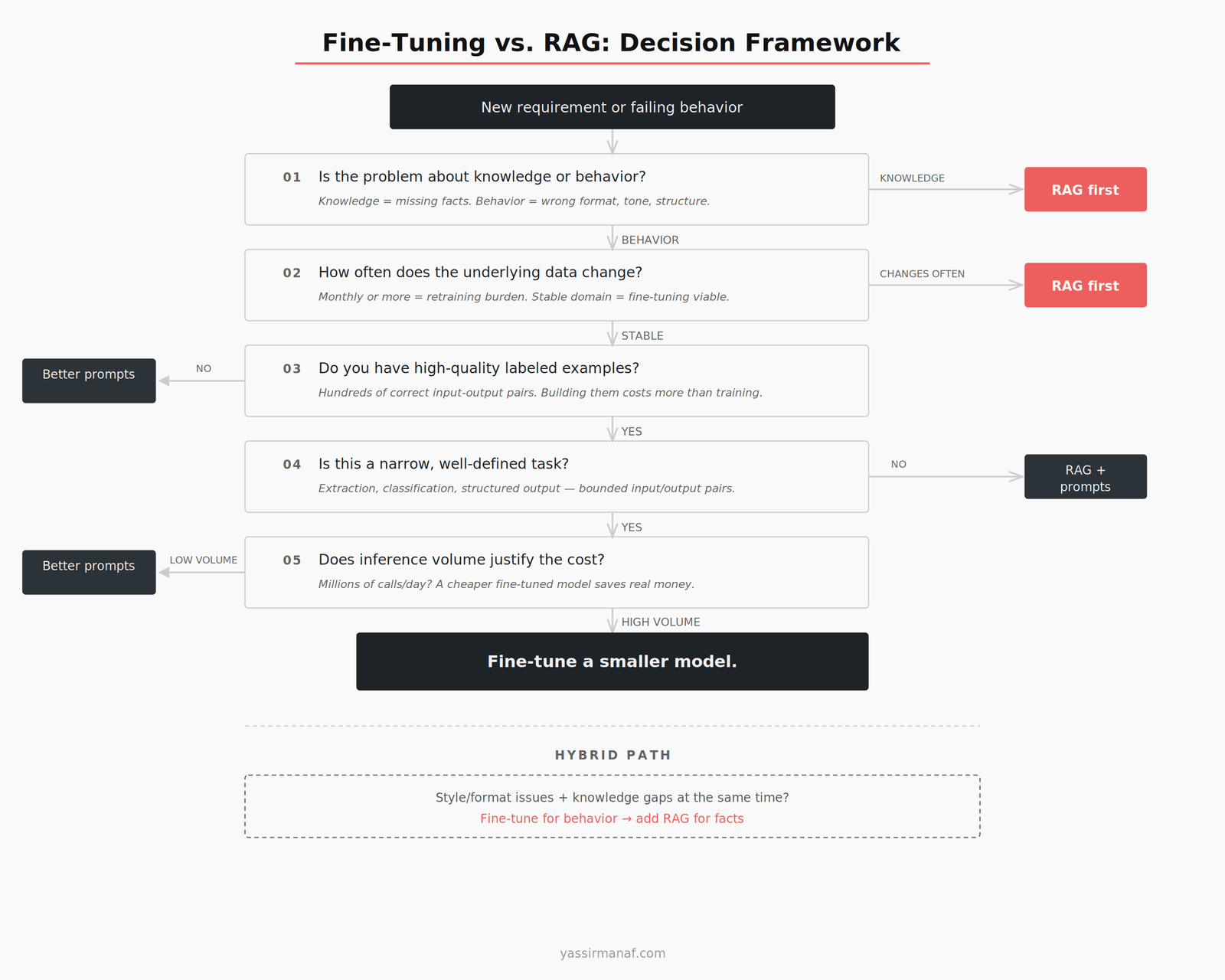
The fine-tuning vs RAG debate gets treated like a philosophy question. It isn’t. It’s an engineering decision with specific trade-offs, and the right answer depends entirely on what problem you’re trying to solve.
I’ve been building AI systems in production since 2017 — conversational pipelines, NLP classifiers, and more recently LLM-based products for clients. In that time I’ve reached for both approaches, gotten the call wrong more than once, and built a decision process I can run through in under an hour. This article is that process.
Start with one question: what’s actually broken?
What Fine-Tuning Actually Changes (and What It Doesn’t)
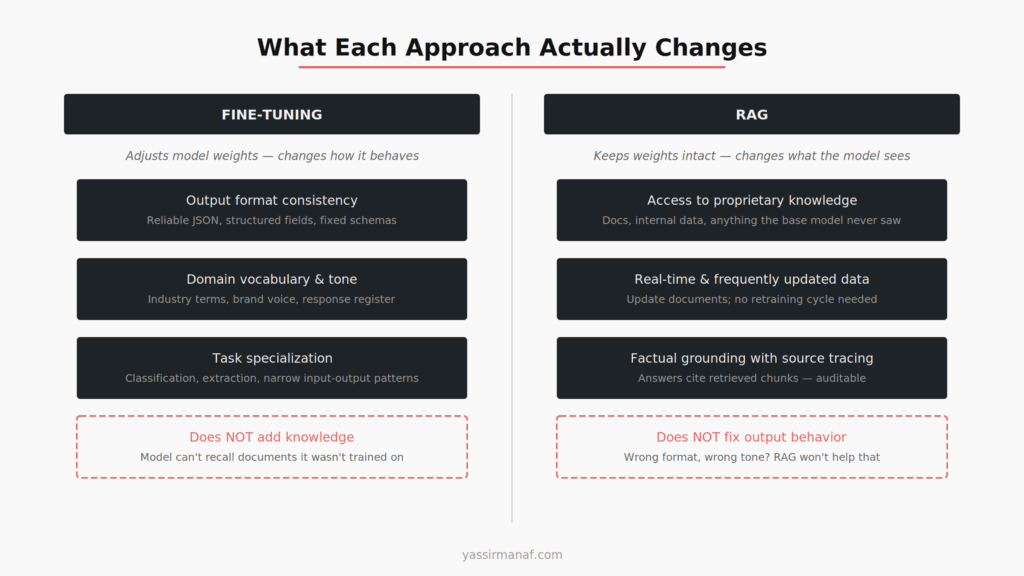
Fine-tuning adjusts the weights of a pre-trained model on your data. It changes how the model reasons and responds — its style, tone, vocabulary, and the pattern of its outputs. It does not change what the model knows at inference time.
This is the most common misconception I see. Teams fine-tune a model hoping it will “know” their product documentation. It won’t. Fine-tuning teaches the model to talk differently. It doesn’t give the model memory of documents it hasn’t been trained on.
What fine-tuning actually improves: output format consistency, domain vocabulary, response tone, and narrow task specialization — classification, extraction, structured output. These are behavioral problems. Fine-tuning is a behavioral tool.
What it doesn’t improve: factual grounding in your documents, real-time knowledge, or retrieval accuracy. If the model is generating wrong facts, fine-tuning is the wrong lever.
What RAG Actually Solves
RAG — retrieval-augmented generation — keeps the model’s weights untouched and gives the model relevant context at inference time. The model doesn’t learn anything new. It gets the right documents dropped into its context window and generates from there.
RAG is the right tool when the problem is knowledge — the model doesn’t have access to information it needs. Your product docs, your internal data, recent events, anything that changes frequently or that the base model was never trained on.
The key constraint: RAG is only as good as your retrieval. If the retriever pulls the wrong chunks, the model hallucinates with confidence using irrelevant context. I’ve spent more debugging time on retrieval pipelines than on model behavior. The infrastructure decisions that affect this are worth getting right before you build — I wrote about what that looks like in LLMs in production.
The other constraint is context window size. You can’t fit everything in the context — you have to retrieve selectively. Bad chunking strategies cause more failures than bad models. Most RAG demos hide this because they use small, clean documents. Production doesn’t.
There’s also a subtler issue: RAG forces you to define what “retrieval” means for your use case. Do you chunk by paragraph, by section, by sentence? Do you embed the chunk alone or with surrounding context? Do you use dense retrieval, sparse retrieval, or both? Each decision compounds into the quality of your final answer. None of it is visible in a demo. All of it matters in production.
The Real Cost of Fine-Tuning
Fine-tuning sounds like a one-time investment. It isn’t.
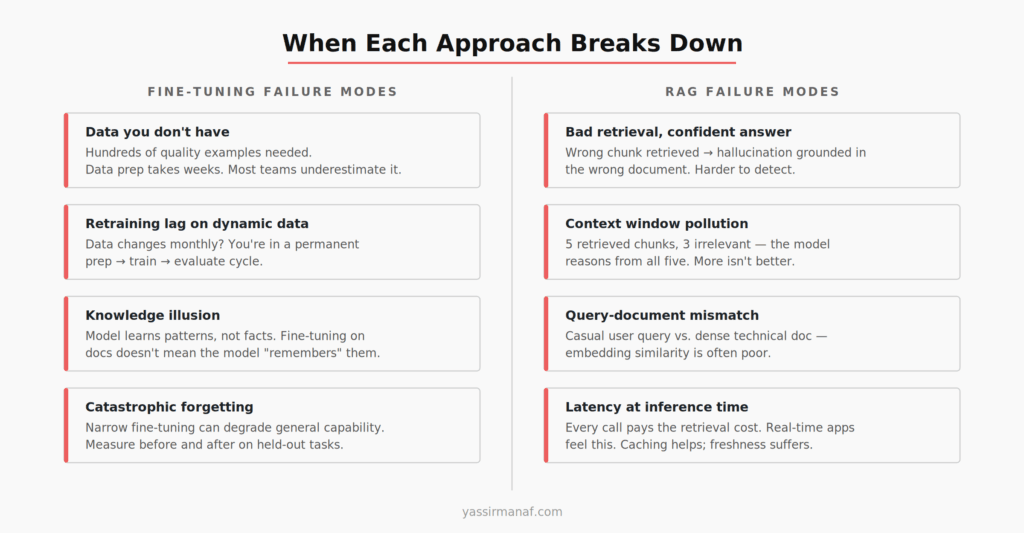
Data preparation is where most of the time goes. You need labeled examples in the format you’re targeting — typically hundreds to thousands of high-quality input-output pairs for meaningful improvement on a narrow task. Collecting, cleaning, and formatting that data is the majority of the work. I’ve seen teams spend three weeks on data prep for a training run that takes four hours.
Training cost varies by model size and provider. For smaller open-source models it’s often cheaper than expected. That’s not the surprise.
Retraining cycles are. Your data changes. Your requirements change. The model you fine-tuned three months ago reflects a reality that no longer exists. Every time your data shifts meaningfully, you’re back to data prep, training, and evaluation. For dynamic domains — anything updated monthly or more frequently — this cycle becomes a permanent operational overhead.
Evaluation is non-optional. You need to know if the fine-tuned model is actually better than the baseline on your specific task. That means a held-out test set and someone who can interpret the results. This is more work than running the training job itself. Skip it and you’re guessing.
One more cost people miss: the deployment pipeline for a fine-tuned model is different from using a hosted API. You’re now managing model versions, serving infrastructure, and rollback procedures. If you’re fine-tuning a smaller open-source model, you’re also managing hosting. These are solvable problems, but they’re not free.
None of this is a reason to avoid fine-tuning. It’s a reason to be honest about the total cost before you commit. The teams that regret fine-tuning usually regret it because they scoped data prep at one week and it took four.
When RAG Fails
RAG has failure modes that aren’t obvious until you’re in production.
Retrieval quality. Semantic similarity isn’t the same as relevance. A chunk that scores high on embedding similarity isn’t always the chunk the model needs. I’ve had retrieval pipelines confidently return the second-most-relevant document because the most relevant one was chunked poorly — cut mid-sentence across a 512-token boundary. The model then generates a plausible-sounding answer from the wrong source.
Context window pollution. When you retrieve five chunks and three are off-topic, the model doesn’t ignore the irrelevant ones. It reasons from all five. More retrieved context is not always better.
Query-document mismatch. The way users phrase questions rarely matches the way documents are written. Embedding similarity between a casual question and a dense technical specification is often poor. Hybrid search — sparse plus dense — helps, but it adds infrastructure complexity and another thing to tune.
Latency at inference time. A RAG pipeline adds retrieval cost to every call. For real-time applications where response time matters, this is a real constraint. Caching helps; freshness suffers.
RAG doesn’t fail because the idea is bad. It fails because people underestimate how much engineering is in “retrieval.” The architecture diagram is simple. The operational reality isn’t.
When Fine-Tuning vs RAG Tips Toward Fine-Tuning
Fine-tuning wins in specific, definable situations. Not generally. Specifically.
You have a narrow, stable task. Classifying support tickets into one of 12 categories. Extracting structured fields from contracts. Generating SQL from natural language over a fixed schema. These are tasks where the input-output pattern is consistent and the labeled data to train on exists.
Style and format matter more than facts. You need responses that match a specific brand voice, write in a particular structure, or avoid certain phrasings. You can prompt toward this, but fine-tuning is more reliable and cheaper at inference time. Prompting has real limits here — I wrote about where those limits show up in the prompt engineering process.
Inference cost is a hard constraint. A fine-tuned smaller model can match a much larger prompted model on a narrow task at a fraction of the per-call cost. At millions of calls per day, this difference is significant. At hundreds of calls per day, the fine-tuning overhead probably doesn’t pay off.
Compliance prohibits external data stores. Some regulated environments can’t use a retrieval system backed by a third-party vector database. If you can’t build the retrieval pipeline, you’re working with what you can bake into the weights. Not ideal, but sometimes the constraint is real.
The Hybrid Case
The question isn’t always fine-tuning or RAG. Sometimes it’s both.
The pattern I’ve used: fine-tune for style and output format, use RAG for facts and grounding. The model learns to behave correctly — structured outputs, right vocabulary, consistent tone. The retrieval pipeline ensures it has accurate, current information to reason from. Neither approach alone gets you there.
The hybrid is more expensive to build and maintain. You’re running a retrieval pipeline and managing a fine-tuning cycle. Don’t reach for it unless you have evidence you need both. Start with RAG. Add fine-tuning if you have a specific behavioral problem that better prompting can’t fix.
I’ve seen the hybrid pattern work well for customer-facing AI assistants in specialized domains — insurance claims, legal intake, compliance checking. The base LLM doesn’t know the company’s document formats or communication style. It also doesn’t have access to the company’s policy documents, which are updated quarterly. Fine-tuning handles the behavioral layer. RAG handles the knowledge layer. Each is solving a different problem.
That’s the test: if you’re combining approaches because you have two distinct problems — one behavioral, one knowledge-based — the hybrid is justified. If you’re combining them because it sounds more robust, you’re adding cost and complexity without a clear payoff.
The decision to combine both should feel forced by constraints, not chosen because it sounds complete. Choosing the simpler option by default is a discipline worth practicing — it applies here as much as anywhere.
My Fine-Tuning vs RAG Decision Framework
Run through these questions in order. Stop when you have an answer.
1. Knowledge or behavior?
If the model lacks facts — information it wasn’t trained on, documents it hasn’t seen, real-time data — start with RAG. Fine-tuning won’t give the model knowledge it doesn’t have. If the model has the right knowledge but produces wrong outputs — wrong format, wrong tone, wrong structure — that’s behavior. Fine-tuning or better prompting.
Most of the time, the first question settles it.
2. How often does the data change?
Monthly or more often: RAG. Documents update immediately, no retraining cycle. Stable domain with slow-moving content: fine-tuning is viable.
3. Do you have labeled examples?
Fine-tuning requires correct input-output pairs. If you don’t have them and building them is expensive, you don’t have the data to fine-tune well. Use RAG and better prompting until you do.
4. Is the task narrow and well-defined?
Fine-tuning works best when the problem space is bounded. Open-ended question answering over a large knowledge base is not a fine-tuning use case. Structured extraction from a specific document type often is.
5. Does the inference volume justify it?
Low volume: the fine-tuning overhead probably doesn’t pay off. High volume with a narrow task: a smaller fine-tuned model can deliver significant per-call savings.
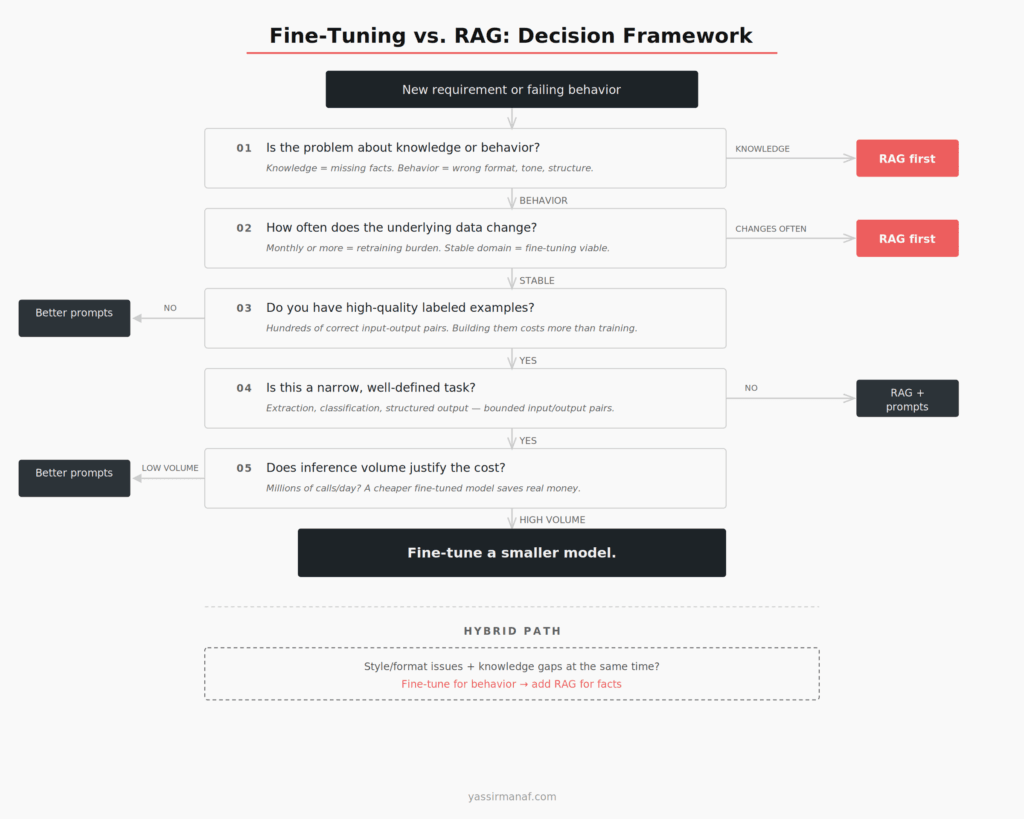
The framework maps cleanly to the options: most paths end at RAG, prompting, or the hybrid. Fine-tuning appears at the end of a specific chain — narrow task, stable data, quality examples, high volume. If you can’t check all of those, the case for fine-tuning weakens.
Sebastian Ruder’s survey of transfer learning methods is worth reading if you want to understand what fine-tuning actually does at the weight level — the intuition matters for making these calls correctly.
The teams I’ve seen get this wrong consistently skip the first question. They fine-tune because they have data, not because they have a behavioral problem. Or they build a RAG pipeline when what they actually needed was consistent output formatting.
The debate is a distraction. The problem is the thing to look at.
Working through a fine-tuning vs RAG decision for a production system? Find me on LinkedIn.
Leave a Reply